

EPR Introduces New Regulatory Rules: Latest UK Packaging News
Most of the modern industries in the UK, from manufacturing to healthcare, all the way to technology, heavily rely on packaging materials, along with single-use plastics. From protective wraps to simple containers to shipping materials, plastic is used in almost everything to ensure hygiene, safety, efficiency & durability. But conversely, widespread use of plastic contributes to waste and increases the carbon footprint across the global supply chain.
Here is an interesting fact: in 2023, the UK generated around 12.7 tonnes of packaging waste, and around 8.15 million tonnes of it was recycled, with an overall recycling rate estimated at around 64% – 75%. The largest segment was paper & cardboard packaging, which formed an overall waste of 5.4 million tonnes with a recycling rate of almost 73%!.
As countries are shifting towards adopting sustainability regulations, businesses are facing extreme pressure to introduce eco-friendly packaging worldwide. Extended Producer Responsibility (EPR) is an emerging and powerful regulatory body that has introduced accountability for UK packaging companies for the life cycle of their packaging. Let’s unpack the recent UK packaging news in detail!
Understanding What is EPR
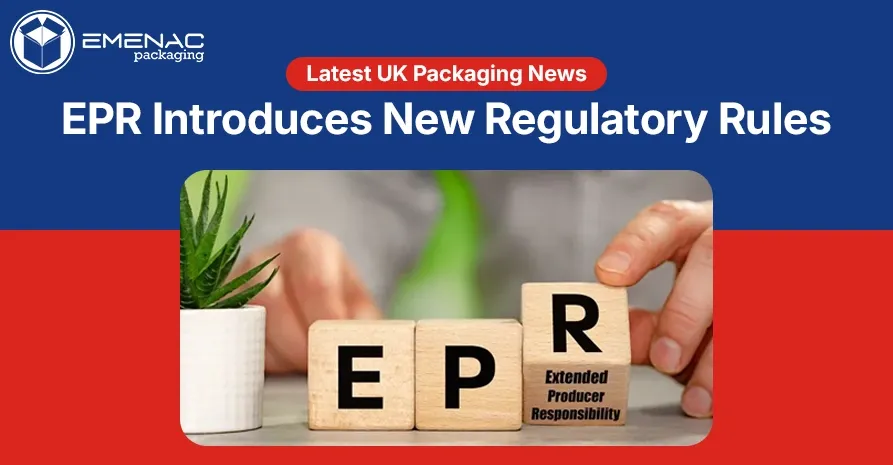
Recently, UK packaging news has been dominated by the word ‘EPR’, but what exactly does it mean? Let’s break it down: it is an acronym for Extended Producer Responsibility; it is a policy that regulates producers and manufacturers to identify and report the entire lifecycle of all their products, even after they become post-consumer waste.
Under the terms of EPR, manufacturers are responsible for the collection, safe disposal, and waste treatment of their products through funding and covering the finances. It is designed to promote enhanced waste recycling, an efficient water treatment system, and more sustainable material choices.
EPR was first limited to the electronics and the packaging sectors but has now become mandatory in other sectors, such as healthcare and life sciences, particularly to regulate single-use plastics.
Why is EPR important in the 2026 economy?
Businesses across all industries are now facing increasing sustainability pressure, especially after EPR’s implementation.
- Due to the rising demand for convenience and safety protocols, the volume of disposable packaging and materials has also increased.
- The existence of difficult-to-recycle waste cannot be eliminated, which adds difficulty to waste treatment and disposal procedures.
- The recycling rate for some materials remains low because of unavoidable factors like composite structures, mixed-material packaging, or contamination, making it challenging to separate the items and to send them further ahead for recycling.
EPR is not only a compliance requirement anymore, but it also represents a promising opportunity and opens the gates of innovation across all sectors.
By identifying and initially adding end-of-life discovery while designing the product packaging, manufacturers can now leave a positive mark on the environment, enhance resource effectiveness, and also improve the brand’s reputation altogether.
EPR Is Crossing All Borders
Governments are now actively implementing EPR regulations globally to reduce waste, encourage sustainability, and limit the use of plastic.
- The European Union is strengthening the Waste Framework Directive and the Packaging and Packaging Waste Regulation (PPWR) to promote EPR measures across all borders.
- Germany and France are also working towards regulating EPR laws, focusing especially on healthcare waste streams.
- In 2024, the UK’s Extended Producer Responsibility for Packaging regulations body began rolling out the guidelines, and the ripple effects can be seen booming in 2026.
- In the USA, a number of states, such as Maine, Oregon, and California, are enacting their own laws, and a widespread federal discussion is unfolding.
How to Design Sustainable Packaging?
Packaging companies are still anticipating how to effectively meet EPR guidelines while maintaining optimal operational performance and finding easy solutions for fulfilling recycling procedures successfully.
- Innovation in Materials: This involves researching and discovering materials that can be used to make the recycling procedure less challenging.
- Partnership with Vendors: Collaborating with suppliers to host such events where the recovery and recycling of used plastics can be done easily.
- Engaging Community: Forming R&D firms and collaborating with communities worldwide to transform contaminated single-use items into high-value and safe recycling feedstock and similar recycling procedures.
Challenges that EPR Might Pose
EPR is creating hurdles for packaging manufacturers, especially those related to plastic packaging. The current fee structure and financial investments to recycle plastic waste are extremely high, while companies are still searching for a one-way solution to combat the use of plastic and also to find ways to increase the ratio of recycling plastic material easily with a low budget.
Since 2025, industries have been facing increasing costs from wages all the way to the recollection, all the way to the recycling phase; all areas have been severely impacted. This is not limited to only the UK, but across all of Europe, around one million tonnes of recycling capacity have now been lost.
Regardless of the challenging conditions of the market, new investments in chemical recycling technologies are gaining momentum, posing a positive outcome for packaging industry producers globally.
Conclusion
UK packaging news related to EPR guidelines has become a recent discussion across the country. EPR regulations might seem challenging in 2026, but with rising awareness regarding sustainable packaging materials, the coming years might witness enhanced recyclability, especially of hazardous materials like plastics.
Innovative materials like polymers and tethered caps are also revolutionising the recycling process. Here at Emenac Packaging UK, we have eco-friendly & sustainable packaging boxes and paper bags; you can check them out at our website.
Thank you for reading our blog!

Having an ability to customize packaging boxes in different sizes, shapes and styles, Emenac Packaging fulfills the requirement of customers in lowest rate with flawless printed results. Not only we accept short and long run orders, we also use high quality Cardboard, Kraft and Corrugated materials to give you unrivaled printing and packaging solutions.
Share This