

The Environmental Impact of Water-Soluble Packaging
As single-use plastics have been on the eradication list of most of the companies and eco-conscious consumers, soluble packaging is the new and innovative solution to solve this problem. This technological advancement offers an ecological answer to reduce plastic waste across the packaging sector.
Did you know Greenpeace and Everyday Plastic’s study found that an average household throws away 3,432 pieces of single-use plastic packaging annually, which increases carbon footprint, as most of it is non-recyclable? Another study shows that the global soluble packaging market was estimated at $3.39 billion in the year 2023 and is forecasted to reach $3.39 billion by the year 2031.
In this blog, we are going to explain how water-dissolvable packaging eliminates the need to use non-biodegradable materials. Additionally, we will explain how the environmental footprint can be reduced using this packaging innovation. This blog will also cover 3 case studies of companies utilising this technology, so don’t skip this informative piece of packaging article, and get to know the environmental impact of water-soluble packaging. Let’s dive in!
What Is Water-Soluble Packaging?
Water-soluble packaging is a new packaging solution that is designed specially to disperse or dissolve when it mixes with water. It is quite the opposite of the conventional plastic packaging that remains in oceans or landfills for hundreds of years. The purpose behind creating water-soluble packaging is to support a sustainable packaging system and reduce long-term environmental waste. This technology is increasingly being used in sectors such as food packaging, personal care products, detergent pods, and single-dose consumer goods.
Advantages of Water-Soluble Packaging
| Advantage | Explanation | Environmental Benefit |
| 1. Efficient Shipping & Storage | Compatible with concentrated product formats like detergent pods | Reduces overall packaging volume and waste |
| 2. Lower Microplastic Risk | Many water-soluble materials leave fewer persistent plastic particles behind | Helps reduce long-term environmental contamination |
| 3. Supports Circular Economy Initiatives | Designed for biodegradation or reduced waste generation | Encourages sustainable production and consumption |
3 Famous Case Studies
Here are the top 3 case studies of brands utilising water-dissolvable packaging:
1. Notpla
Notpla recently came into the limelight for developing a seaweed-based disposable and edible pouch that is specially designed to replace the use of single-use plastics for sauces or liquids. The company has already achieved global recognition for utilising renewable seaweed-based material while replacing petroleum-based plastics, which has helped lower environmental pollution, as well as supporting a circular packaging economy.
2. MonoSol
MonoSol is an American company well-known globally for producing AquaFilm. If you are unaware of it, let us explain the meaning behind it. It is a water-soluble film technology that is usually used in laundry detergent pods as well as dishwasher capsules. The most amazing feature of this film is that it completely dissolves into water and is also designed to biodegrade naturally under accurate environmental conditions.
MonoSol quotes that the technology is not only useful to reduce packaging weight but also requires reduced shipping weight and storage space as compared to other plastic packaging. The company also put forward the claim that even the used material does not disperse as solid plastic particles, which have a healthy impact on the environment.
3. SmartSolve
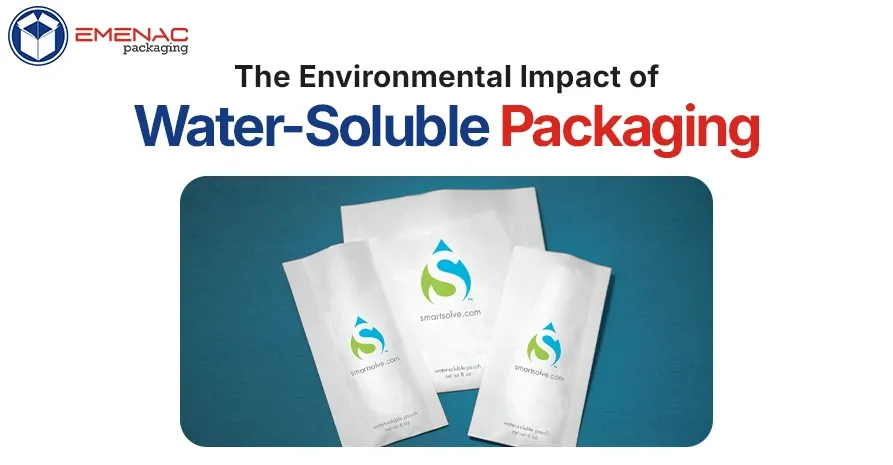
SmartSolve has also launched a new water-dissolvable packaging developed primarily from bio-based ingredients and wood-pulp fibre. This packaging material can naturally biodegrade in water through microorganisms, which in turn assists brands in reducing the overall plastic pollution and landfill waste.
Another great innovation by the company is PureNil, which is promoted as plastic-free packaging that is not only flexible but also 100% bio-based and used for dry materials such as snacks, coffee, cleaning products, or personal care items. The company further claims that the packaging material easily disperses in water and does not release any harmful micro-organisms, and can even be developed through standard packaging machinery. Your brand can even adopt this packaging easily and achieve sustainability goals by just switching to this next-generation water-dissolvable packaging technology.
The Environmental Impact Of Water-Soluble Packaging
Conventionally, plastic packaging has proven to be a big contributor to landfill accumulation and increasing marine pollution. According to data shared by the OECD, the global production of plastic annually is estimated to be around 460 million tons, consequently generating around 353 million tons of plastic waste each year.
Water-dissolvable packaging is designed to reduce the catastrophic impact of plastic packaging through the following:
- Reducing ocean waste and landfill.
- Encouraging renewable and biodegradable materials.
- Supporting low-waste and lightweight packaging.
- Lowering microplastic pollution.
Another great feature associated with water-dissolvable packaging material is that it is also compatible with concentrated materials, which in turn can lower shipping emissions as well as packaging volume. Nevertheless, industrial scalability, proper disposal systems, and transparent certifications still remain significant bottlenecks for the industry.
Wrap Up
Water-dissolvable materials are getting the limelight in packaging as they offer a convenient way to deliver products in a sustainable way, replacing the need for plastic packaging. Additionally, these materials replace the need for recycling or disposal, which consequently minimises waste management.
In this blog, we have discussed the features and environmental impact of water-soluble packaging, 3 popular case studies associated with developing this innovative technology, and how it is encouraging a circular economy. Here at Emenac Packaging UK, we support a greener planet and offer custom packaging according to your brand requirements. Send us an email for further enquiries!
Thank you for reading our blog!

Having an ability to customize packaging boxes in different sizes, shapes and styles, Emenac Packaging fulfills the requirement of customers in lowest rate with flawless printed results. Not only we accept short and long run orders, we also use high quality Cardboard, Kraft and Corrugated materials to give you unrivaled printing and packaging solutions.
Share This